
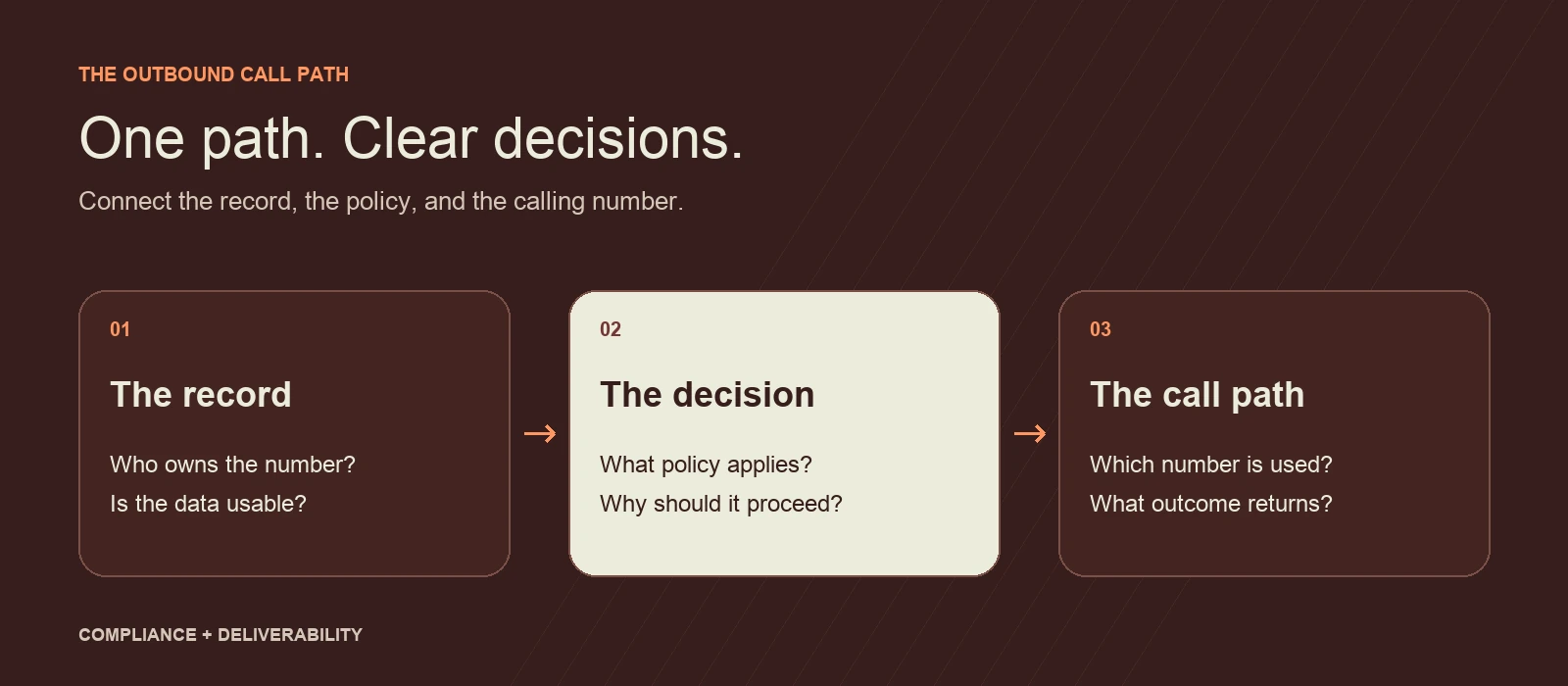
Your outbound program needs a clear decision before each call: should this record enter the calling workflow, and what has to happen next? Compliance and deliverability provide different parts of that answer. Treating them as unrelated work creates handoffs that operations teams then have to explain, reconcile, and maintain.
A useful starting point is the call path itself. Follow a record from the source system to the dialer. Identify the information used, the policy applied, the number presented, and the result returned. That path shows where decisions belong and where an unanswered question can become a manual task.
Start With the Record, Not the Tool
The customer relationship management system may hold a name and phone number. The dialer may be ready to call. Between those two systems, the operation still needs to understand the record and apply its calling policy. A phone number in a database does not explain who currently owns it, whether the data is usable, or why a particular workflow should proceed.
Write down the questions your program needs to answer. Keep data quality, permission, caller identity, and delivery separate. They are related signals, but one does not establish another. A recognizable caller name cannot establish permission to contact someone. A clean record does not establish that a person will answer.
Make Each Handoff Visible
Map the systems that touch a record. For each handoff, capture the input, output, owner, and next action. Include the steps performed in spreadsheets or file transfers. They often contain operating knowledge that disappears from an integration diagram.
- Where does the original record come from?
- Which checks run before it enters a campaign?
- Which decision reaches the dialer?
- Who investigates a rejected record or a delivery problem?
| Handoff | What to record | Next action |
|---|---|---|
| Source record | Record source, phone number, and data quality. | Confirm the input before campaign checks. |
| Compliance decision | Policy applied and reason returned. | Review accepted and rejected records. |
| Calling number | Inventory, usage, and reputation signals. | Investigate labels or blocked calls. |
| Call outcome | Connection and right-party contact outcomes. | Assign follow-up to the affected step. |
Give Compliance and Deliverability Distinct Jobs
Compliance controls help an organization apply its outreach policies and the requirements relevant to its program. Deliverability work addresses how a call travels and how its identity and number reputation are handled. Both affect the same calling operation, so the team needs visibility across both.
The Sonera platform organizes outbound work across data enhancement, compliance, deliverability, communications, and orchestration. That structure is useful for reviewing a call path. It gives each stage a job without asking the dialer to become the owner of every upstream decision.
Preserve the Reason Behind the Decision
A result that says only accepted or rejected can leave the next team guessing. Ask what information informed the result, which policy applied, and what action follows. Operations needs a reason it can investigate. Compliance needs the context it can review. Technical teams need an output their software can handle consistently.
A decision record also needs boundaries. Specify what the check covers and what it does not establish. A signal about number reputation is not a conclusion about consent. A successful connection is not proof that the intended person answered. Keep those distinctions in reports as well as workflows.
Review the Calling Number Alongside the Record
A campaign can have usable records and still encounter problems with its calling numbers. Reviewing only the list leaves part of the operation unseen. Include number inventory, usage, monitoring, and the process for investigating labels or blocked calls in the same operational review.
Sonera describes monitoring, remediation, and number-pool management as parts of its deliverability layer. When evaluating that work, ask what the team can observe, who owns follow-up, and how an issue changes the next campaign decision. Avoid treating a change of number as an explanation by itself.
Use a Shared Framework for Investigation
Consider a campaign where fewer intended recipients are reached. The useful question is where the call path changed. Review the source records, the decisions returned, the number pool, and the outcomes captured. Compare equivalent groups before drawing a conclusion. A headline metric alone cannot explain which step needs attention.
A practical review can follow this sequence:
- Confirm the records and campaign settings being compared.
- Review accepted and rejected decisions with their reasons.
- Check the calling numbers and any reported reputation issues.
- Separate connection outcomes from right-party contact outcomes.
- Assign the next action to the team that owns the affected step.
This is an investigation framework, not a promised customer result. Its value is a more specific question and an accountable next action.
Connect the Controls Without Replacing Your Stack
A control plane is the layer that makes decisions about a workflow while the execution system performs the work. In outbound calling, that means placing decision logic between the data sources and the dialer. The integration should make inputs, outputs, exception handling, and ownership easier to understand.
Before choosing a tool, take a current campaign through the map. Ask each owner to explain one successful path and one exception. Then identify the handoff that creates the most uncertainty. That gives the team a concrete starting point for improving the operation, whether the next step is clearer documentation, a policy review, or a better-connected workflow.
This article is for general information only and is not legal advice. Consult a qualified attorney about your specific situation.